
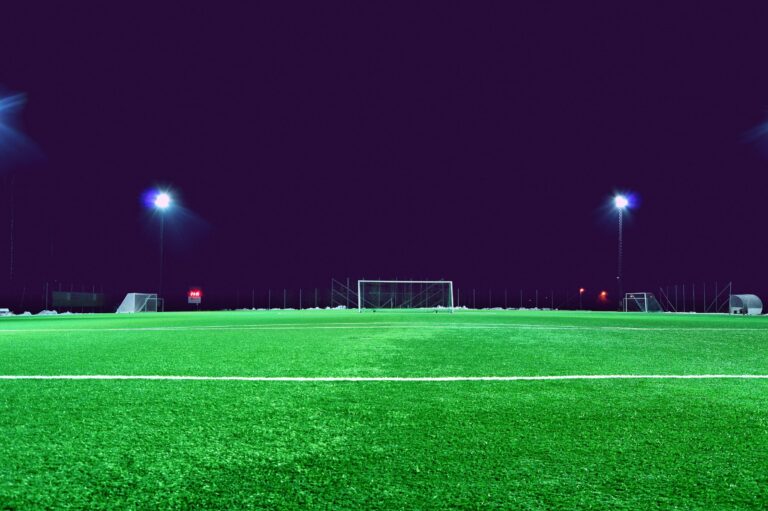
The meaning of a “sports facility” needs no explanation, but a short commentary might be in order regarding the meaning of the terms “outdoor” and “recreational”. An outdoor facility is generally understood as a structure located outside, i.e., “in open air” – usually roofless and with lighting installed on posts/masts. Recreational facilities, in turn, are structures that are illuminated to cater to the comfort of the users – without considering the specifications required for cameras or TV transmission. Thus, this term refers to small structures such as playgrounds, medium-sized structures such as skate parks or multi-purpose fields or large facilities such as athletics stadiums or full-sized football fields.
The normative requirements for such facilities are regulated in standard 12193, “Sports lighting”. Depending on the sports discipline and competition level, the standard distinguishes the following classes:
- class I: league level,
- class II: local competitions, training,
- class III: training, recreation.
In the case of the most popular sports disciplines in Poland, the illuminance level in the playing area usually ranges from 50 to 750 lx. In most cases, we will use table A.21 (included in the above-mentioned standard) for outdoor sports, which include basketball, volleyball, handball and football. Table A.21 lists the requirements for the individual competition classes:
| Competition class | Em [lx] | Emin/Em |
| I | 500 | 0.70 |
| II | 200 | 0.60 |
| III | 75 | 0.50 |
We will also certainly often need to refer to table A.16, which is used for tennis courts:
| Competition class | Em [lx] | Emin/Em |
| I | 500 | 0.70 |
| II | 300 | 0.70 |
| III | 200 | 0.60 |
For other sports disciplines, e.g., athletics, cycling or skate parks, we will have to use relevant tables in standard 12193, “Sports lighting”.
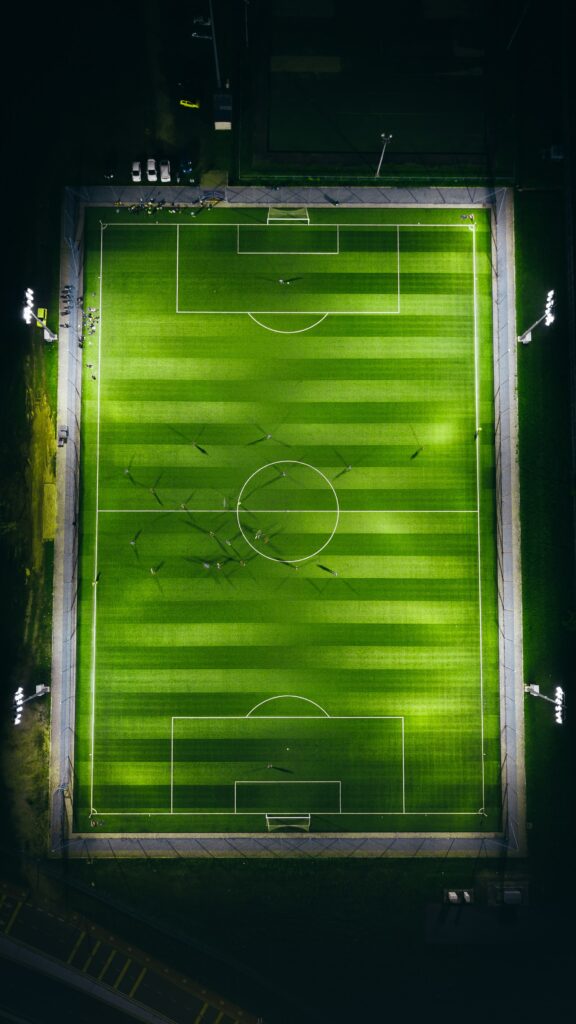
In addition to illuminance levels and uniformity, the standard also includes guidelines for other aspects, e.g.:
- colour rendering index,
- glare rating,
- reference grid,
- recommended reflectance for different sports surfaces,
- amount of obtrusive light in the vicinity of the illuminated facility.
What to pay attention to – apart from the standards – when designing lighting for an outdoor recreational sports facility?
Certainly, where the geometry of the structure permits this, you should use luminaires with asymmetric beam, installed with a nadir of zero degrees or with the minimum possible nadir. This is not always possible, e.g., when the posts are too low or located too far away from the playing field. Asymmetric luminaires reduce and significantly limit the amount of obtrusive light emitted outside the playing field. A very important aspect is the choice of the luminaire itself as well as the experience of the designer. When choosing the luminaire, in addition to the parameters already mentioned, you should also pay attention to the following:
- service life,
- luminous efficacy,
- ease of installation and maintenance,
- mass and wind resistance area.
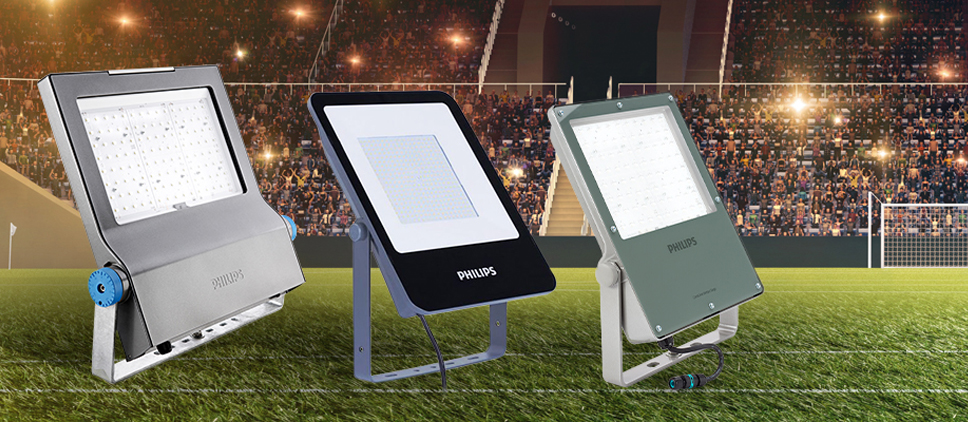
We particularly recommend the following solutions from the PHILIPS range:
- for class-I facilities – OptiVision LED (BVP528/518), ClearFlood Large (BVP651) and ClearFlood (BVP650) product groups,
- for class-II facilities – the CoreLine Tempo (BVP140/130/125) product group,
- for class-III facilities – the Ledinaire Floodlight (BVP165) product group.

Author: Marcin Bocheński
Product Manager, Signify